Operations
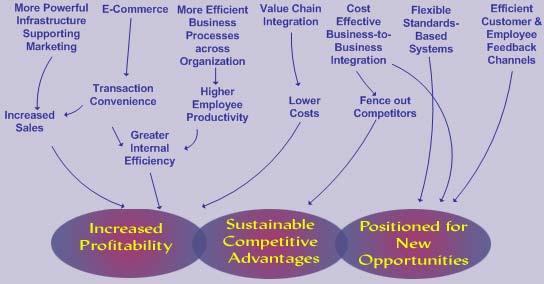
EBusiness technologies provide standardised, cost-effective ways to integrate operations across mulitiple business locations. Furthermore, they give single location businesses the flexibility to expand to multiple locations. Businesses can reap significant savings in physical infrastructure costs and travel costs by enabling employees to work from home, on location, or out on the road. Typically this results in higher employee productivity gains, by taking the time-wasting 'friction' out of each employee's work processes.
More Powerful Infrastructure Supporting Marketing -- Marketing can be supported using Internet enabled commercially available Customer Relationship Management (CRM) systems. These systems can be enhanced to support unique marketing strategies. Alternatively, customised CRM systems can be assembled inexpensively from available system components to match your marketing needs.
E-Commerce -- Exposing products/services on a standard website has caused an explosion of online sales across the world. Every business should have information about their business offerings on a standard website and at least should be looking to enable customers to effect immediate transactions online. The convenience to customers is compelling and should be an important part of any business strategy today. For the future, businesses can gain substantial competitive advantage by integrating e-Commerce into each prospect/customer's website portal. This requires that e-Commerce be implemented in a customisable form not only to project a business's products/services to individual customers, but also to interface with potential business partners.
Value Chain Integration -- By adopting standardised external system interfaces (e.g., 'web services'), you and your value chain partners can enjoy highly efficient integration of your business processes. Because the cost of implementing these interfaces is very modest, the only barrier to value chain integration is usually the awareness and will of the partners.
Cost Effective Business-to-Business Integration -- EBusiness technologies also provide a huge opportunity to make your business 'partner friendly'. By providing your internal business processes with Internet-enabled interfaces, you position your business to link with potential partners. This opens up the possibility for new product/service combinations, unexpected new service offerings, additional marketing channels, and technology exchange. These forces are driving the future of business towards a 'project-oriented' paradigm (like the movie business).
Efficient Customer & Employee Feedback Channels -- EBusiness technologies enable the establishment of an operational infrastructure that enables real-time customer and employee feedback. This information can be impact the system itself, and customer, employee, and financial strategies, thus empowering management with greater business controls. [As an example of this, today the CISCO CEO can see up-to-the-minute data on all important management information across his worldwide organisation.]